Why should you have a Digital Twin
First: what a Digital Brain actually is
A Digital Brain is a living copy of what you know, how you think, and how you sound - one that keeps growing whether you're paying attention or not.
It's built from four layers:
Your expertise and knowledge. Everything you've learned, written, argued, built, or figured out the hard way. You feed it documents, notes, past work, half-formed ideas. It doesn't just store them - it connects them. And unlike a static profile, it gets denser every week.
Your socials, on autopilot. Connect your accounts once and your Brain updates itself. You post a thread on X, publish something on LinkedIn, ship a video - your Brain already knows. You don't maintain it. It maintains itself from the trail you're already leaving.
Your communication style. Everyone speaks differently. Some people are blunt. Some build up to the point. Some answer a question with a better question. Your Brain learns your rhythm - your vocabulary, your structure, your particular way of explaining things - so what comes out of it reads like you, not like generic AI slurry.
Your voice - and soon, your face. Text is the beginning. Your Brain will speak in your voice, and eventually appear as your avatar. Same knowledge, same style, now with presence.
Put together: a version of you that scales.
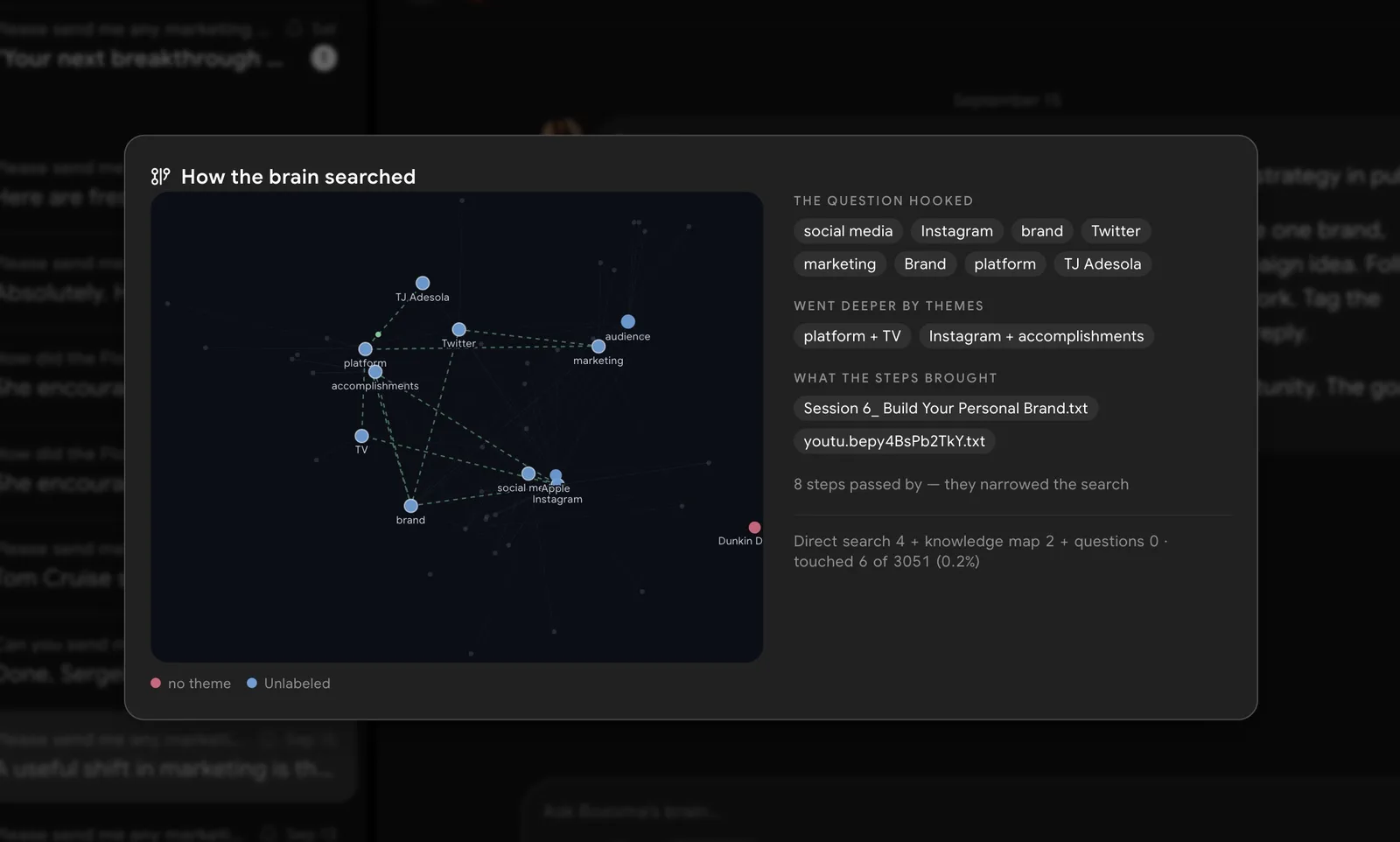 You can literally see how your brain answers
Why you want one
- It represents you, so you stop repeating yourself
You have answered the same question a hundred times. What do you charge? How did you build that? What's your take on X? Can I pick your brain for 5 minutes?
Every one of those conversations costs you something, and most of them cost you the same thing twice.
Your Brain handles them. It answers in your words, with your actual reasoning - not a canned FAQ. And it does it at 3am while you sleep, on a Sunday, in a timezone where you don't exist yet. You can't be everywhere. It can.
- It works - for you, or for other people
This is where it stops being a profile and starts being infrastructure.
Connect it to your socials. Point it at a stack of documents and ask what matters. Have it draft content in your voice. Generate images. Set reminders. Run the errands of knowledge work that eat your day without advancing it.
And it doesn't only work for you. Others can put it to work too - your clients, your audience, your team. Your Brain becomes something people consult, not just something they read.
- It knows your world and the wider one
Most AI tools know either your private context or the public internet. Your Brain knows both, at once.
It searches the web on your behalf. It flags when something appeared that you'd care about - a competitor moved, your name came up, a paper dropped in your field. It plugs into your workspaces: Slack, your drive, your tools. And other people can plug it into theirs, so your expertise shows up where their work actually happens.
Private knowledge plus live web plus your workspace. That's a different animal from a search box.
- It can be private, public - or profitable
Keep it locked to yourself: a second memory, a thinking partner that has read everything you have.
Open it to your team: institutional knowledge that doesn't walk out the door when someone resigns.
Make it public: your expertise, available to anyone, priced how you like. It earns while you're doing something else. (That deserves its own article - and it has one.)
Same Brain. You choose the door.
- You talk to it however you want
Type at it. Or call it and talk. Walking, driving, between meetings - the interface should bend to you, not the reverse. Voice makes it feel less like querying a database and more like thinking out loud with someone who happens to have perfect recall.
- Brains connect to other Brains
This is the part people underestimate.
Your Brain can talk to other Brains. Plug in your lawyer's, your designer's, your co-founder's, a specialist you've never met. They can work on a problem together. They can disagree in front of you - which is often more useful than agreement, because you get three real perspectives instead of one averaged mush.
One Brain is a tool. A network of Brains is a new way to work.
- It makes you better, not just faster
Your Brain notices gaps. It sees what's thin in your bio, what your experience implies but never states, patterns in how you behave that you've never named out loud.
It tells you. "You keep referencing this framework but you've never actually written it down." "Three people this week asked you something you have no good answer for."
Used honestly, it becomes a mirror - a nudge toward the version of you that exists in your head but hasn't made it into the world yet.
- It lives wherever you do
Your Brain isn't trapped in PickMyBrain. Embed it as a widget on your site, your blog, your app, your product docs, your portfolio. Your audience talks to you where they already are. One Brain, many front doors.
- It compounds
Everything else on your laptop decays. Notes go stale. Bookmarks rot. Docs get buried three folders deep and never surface again.
A Brain does the opposite. Every document, every post, every conversation makes the next answer sharper. It's the first asset you own that's worth more in year three than year one - and it doesn't need you to organize it.
- For a company, it's memory that survives turnover
Companies lose knowledge constantly. A senior engineer leaves and takes eight years of "why we did it that way" with her. Onboarding takes six months because the real knowledge was never written down - it lived in people.
A company Brain holds it. New hires query it on day one. Support answers from it. Sales stops reinventing the same deck. The organization stops forgetting.
The part that makes it trustworthy: you can see the wiring
Here's the problem with every AI answer you've ever read: you have no idea where it came from. It sounds confident. Is it right? Did it make it up? No way to tell.
Your Brain shows its work.
Every answer comes with receipts. Not a vague "based on your data" - the actual chunks. This sentence came from that document, page 4. This claim came from a post you wrote in March. This came from a live web result pulled 30 seconds ago. You can click through to the source. So can whoever you shared it with.
That changes the relationship. You're not trusting a black box. You're reading a cited argument, and the citations are yours.
And you can see the whole Brain as a graph. Not a list - a map. Thousands of nodes: documents, posts, ideas, conversations, concepts. Lines between them where they connect. Dense clusters where you're deep. Sparse regions where you're thinner than you thought. Unexpected bridges between things you never realized were related.
Most people have never seen the shape of their own knowledge. It's a strange experience. It's also useful: you find the gaps, you find the themes you didn't know were themes, and you find out what you actually know versus what you assume you know.
Why this becomes normal
Ten years ago, "everyone will have a personal website" sounded like a niche hobby. Now not having one is the weird choice.
Digital Brains are on the same curve, for the same reason: the cost of not having one keeps rising. If your competitor's expertise answers questions instantly, at scale, in their voice, with sources — and yours is a static PDF and a calendar with no openings — you're not losing on quality. You're losing on availability.
The future isn't one giant AI serving everyone the same answers. It's millions of specific brains, each carrying a real person's real knowledge, talking to each other, working for their owners and for anyone their owners let in.
Somebody's Brain is going to answer the question you're the best in the world at answering.
Better that it's yours.!